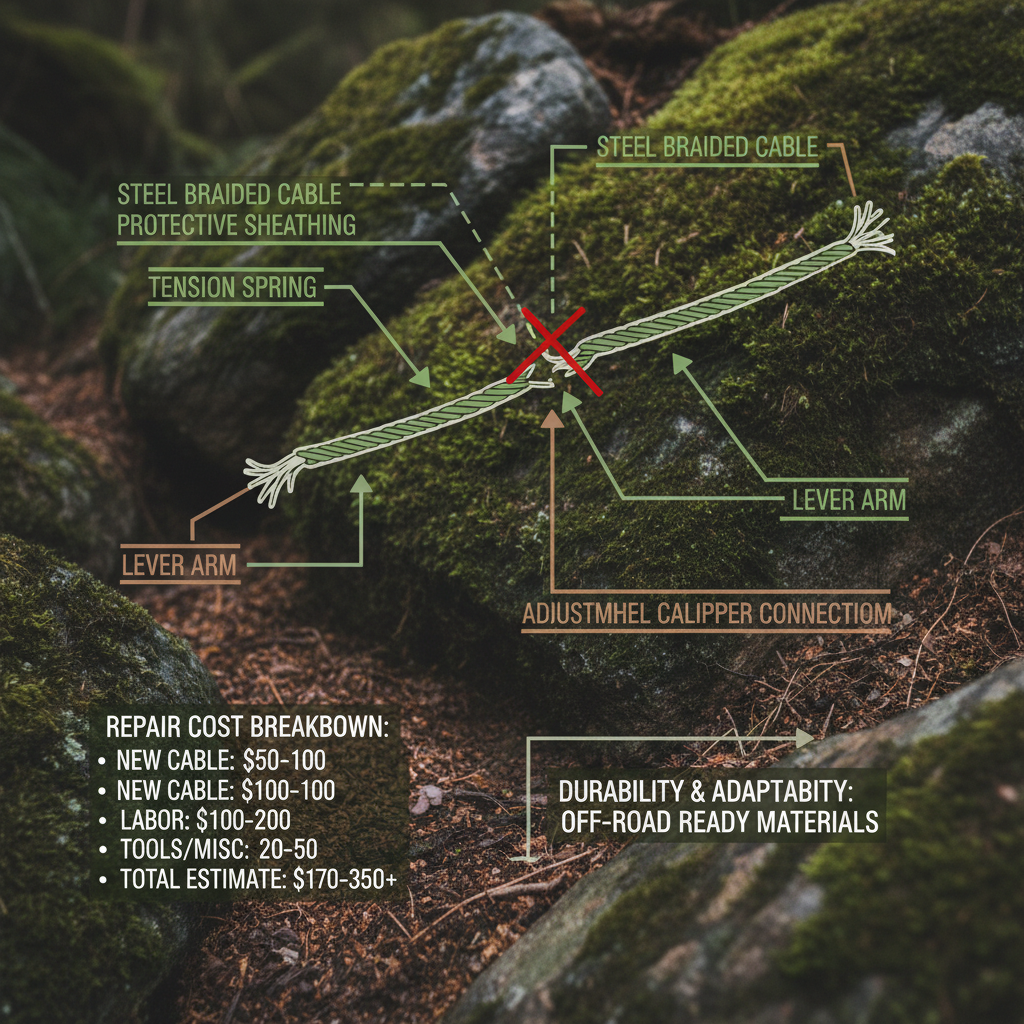
Precise throttle response is the heartbeat of vehicle acceleration, relying entirely on the mechanical integrity of the link between the pedal and the engine. When standard components fail to meet the specific routing requirements of modified engines or specialized vehicle chassis, the reliance shifts toward precision-engineered alternatives.
The challenge in automotive cable manufacturing lies in balancing flexibility with tensile strength, ensuring that no signal loss occurs between the driver's foot and the throttle plate. This is particularly critical in high-performance or industrial applications where any lag in power delivery can compromise safety and vehicle control.
To address these specific mechanical demands, sourcing a custom throttle cable allows engineers to optimize the path of transmission and material selection for maximum durability.


The accelerator cable assembly functions as the primary physical bridge between the operator's input and the engine's power output. By transmitting the linear movement of the pedal to the throttle valve, it directly modulates the air-fuel mixture entering the cylinders, thereby controlling the vehicle's speed.
In modern mechanical systems, the stability of this transmission is paramount. Any friction within the cable housing or stretching of the inner wire leads to "throttle lag," where the engine does not respond instantaneously to the driver's input, potentially impacting safety during critical maneuvers.
Designing an effective control cable requires a deep understanding of the physical routing within the engine bay. The cable must navigate complex geometries without creating sharp bends that would increase internal friction or cause premature wear on the outer conduit.
Key design variables include the "stroke length" (the total distance the inner wire moves) and the "free play" (the initial gap before the throttle begins to open). An incorrectly calculated stroke can lead to a throttle that cannot fully open or a pedal that remains under tension when released.
Precision in the termination ends—the fittings that connect the cable to the pedal and the throttle body—is equally critical. These components must be securely crimped and ergonomically shaped to prevent detachment under high-tension operating conditions.
The environment surrounding a throttle cable is hostile, characterized by extreme temperature fluctuations, exposure to road salt, oil, and constant vibration. Consequently, the choice of materials defines the lifespan of the assembly.
Stability under variable working conditions is achieved through the synergy of high-tensile steel inner cores and low-friction polymer liners, ensuring that acceleration remains smooth regardless of external climate.
To ensure these standards, rigorous quality control processes are implemented. Testing typically involves cycle-testing the cable thousands of times to simulate years of use, verifying that the material does not stretch or fray. Companies like Qinghe Hangwei Parts Co., Ltd. employ these strict verification methods to ensure their assemblies operate reliably across various vehicle models.
The efficiency of a throttle assembly can be measured by its "Transmission Efficiency Index," which compares the input force at the pedal to the actual movement of the throttle plate. Higher efficiency means less energy is lost to friction, resulting in a more responsive driving experience.
When comparing standard off-the-shelf cables with customized versions, the primary difference lies in the optimization of the routing and the precision of the materials used. Customized solutions typically exhibit lower friction coefficients and higher stability over time.
Custom cables are essential in a typical industrial setting where vehicles are modified for specific tasks, such as agricultural machinery or specialty transport. In these cases, the engine may be relocated or the chassis lengthened, rendering standard accelerator cables useless.
Furthermore, high-performance automotive tuning often involves replacing the factory intake or throttle body. A custom-tailored assembly ensures that the new hardware is actuated precisely, maintaining the intended power curve and preventing hazardous throttle sticking.
The industry has moved from simple braided wires to complex multi-layered assemblies. Modern control cables now integrate advanced lubricants and synthetic coatings that significantly reduce internal wear, extending the interval between replacements.
While "drive-by-wire" electronic systems have become common, mechanical cables remain indispensable for safety redundancies, heavy-duty machinery, and classic vehicle restorations. The demand for high-quality mechanical links persists because of their reliability—they do not suffer from electrical failures or sensor glitches.
The current trend emphasizes modularity, where the outer housing and inner core can be optimized separately based on the specific tension and bend requirements of the vehicle's architecture.
When procuring a custom control cable, buyers must move beyond simple length measurements. The evaluation should focus on the interplay between the cable's flexibility and its resistance to elongation under load.
It is critical to assess the manufacturer's certification standards, such as ISO9001 or ISO16949, which guarantee that the production process is consistent and the materials are traceable. This ensures that the custom part will perform identically to the original equipment.
The following framework illustrates the trade-offs and requirements when selecting between different cable configurations based on the application environment.
| Scenario | Primary Requirement | Material Priority | Risk Factor |
|---|---|---|---|
| High-Performance Tuning | Low Friction / Fast Response | Teflon-Lined Housing | Throttle Lag |
| Heavy Duty Industrial | High Tensile Strength | Galvanized Steel Core | Cable Stretching |
| Off-Road/All-Terrain | Environmental Sealing | Reinforced PVC Jacket | Contamination |
| Classic Restoration | Original Fitment Accuracy | Standard Braided Steel | Routing Interference |
| Specialty EV Hybrids | Precision Actuation | Low-Stretch Alloys | Alignment Shift |
| Agricultural Machinery | Corrosion Resistance | Stainless Steel/Polymer | Chemical Oxidation |
A custom throttle cable is engineered to specific dimensions, routing paths, and material requirements that differ from factory specifications. This typically involves unique lengths, specialized end-fittings, or enhanced housing materials to accommodate engine swaps, chassis modifications, or extreme operating environments where a standard cable would either be too short, too long, or prone to premature failure due to improper routing.
The housing serves as the guide for the inner wire. If the housing is made of low-quality polymers or has an uneven internal diameter, it increases friction. This friction manifests as a "heavy" pedal feel or a delayed response (lag) during acceleration. High-quality housings use low-friction liners and precise extrusion to ensure the inner cable glides smoothly, providing an immediate and consistent link between the pedal and the engine.
The most frequent failure points are the termination ends (where the cable attaches to the pedal or throttle) and the areas of maximum curvature in the routing. Fraying often begins at these stress points. Additionally, ingress of dust or moisture into the housing can degrade internal lubrication, leading to increased friction and eventual snapping of the inner wire. Using high-grade seals and corrosion-resistant materials can mitigate these risks.
Yes, if designed correctly. A custom cable optimizes the routing to eliminate sharp bends and unnecessary tension, which reduces the wear rate on both the cable and the throttle linkage. By selecting materials specifically suited for the environment—such as stainless steel for coastal areas or heat-resistant jackets for tight engine bays—the overall lifespan of the acceleration system is significantly extended compared to using an ill-fitting standard part.
Accurate procurement requires three main data points: the exact overall length of the assembly, the specific dimensions and shapes of the end-fittings (often provided via technical drawings or samples), and the required stroke length. It is also helpful to provide information on the operating environment (e.g., high heat, chemical exposure) so the manufacturer can select the appropriate outer jacket and inner core materials for durability.
Absolutely. Mechanical cables provide a direct, fail-safe connection that does not depend on sensors, ECU logic, or electrical power. They are preferred in heavy machinery, racing applications for "raw" feel, and classic car restorations. Furthermore, many industrial systems maintain mechanical backups for safety. The focus has simply shifted toward higher precision and better materials to match the performance of electronic systems.
The precision of a vehicle's acceleration is only as reliable as the mechanical link that controls it. While often overlooked, the transition to a custom-engineered throttle assembly eliminates the compromises of generic parts, ensuring that power delivery is linear, responsive, and safe across all operating conditions.
By prioritizing material science and precise routing design, operators and manufacturers can ensure long-term stability and reduce the risks associated with mechanical failure. Whether for industrial specialization or automotive performance, the investment in a tailored control solution is an investment in vehicle reliability.